Monday, May 17, 2010

Regina


My friend Duncan has started a photo project called Perspectives of Poverty. The project pairs two images: the first image shows one of his friends looking stereotypically 'poor' (the more common type of image coming out of Africa), and second one shows the person dressed to impress. He wants to change people's perceptions of Africa. I thought that it was a great project, and I inadvertently (and with much less photographic skill) conducted my own photo experiment.

Last time I was visiting Tchale village I was happy to see that Regina had learned to walk since my last visit. (She's a niece and neighbor of the Tchale family.) As she was toddling around I took a few quick pictures. As soon as I'd taken the photos her mom swooped in and it was bath time (beloved by all children). Then, Regina returned clean and dressed in her best (I've printed many of the photos I've taken in the village and given them to their subjects - so now I may have a reputation that I'll have to continue to fulfill). I obliged and took a few pictures of Regina. The differences are quite striking. Bear in mind it's the same child in the same place, only ten minutes apart.

Check out Duncan's project at: http://waterwellness.ca/2010/04/28/perspectives-of-poverty/

Friday, May 14, 2010

Rollins Chitika

Next in my short series on inspiring, and capable Malawian leaders: Rollins! Rollins used to work alongside me in the M&E department (and he was invited to EWB’s National Conference in Canada). Now, he’s moved on to bigger and better things and he’s using his knowledge and skills to run an output-marketing project for VSO. Rollins is also very well educated. He has a Bachelors degree in Agricultural Science and a Masters in Agricultural Economics.

Rollins research project for his Masters degree involved working with and learning about the dairy sector in Malawi. Dairy farmers in Malawi are not very well compensated for their work because milk can be imported at lower prices and milk wholesalers have even been known to reconstitute milk powder for resale because it’s cheaper than buying and processing local milk. Rollins has had two articles published in Malawi’s national newspapers about the difficulties facing the sector.

Now, Rollins and Mathias are working together (along with a few others) set up a charity to help send children in Malawi’s rural areas to school. Their plan is to find high performing children whose parents cannot afford to send them to school. Then, they want to pay the school fees for these children and provide extra support for these children in theirs homes. They both believe in making a difference in Malawi and they both believe in the power of education to provide people with opportunity.

Thursday, May 13, 2010

Mathias Mbendela

Mathias works for the same NGO as I do in Lilongwe. He is a good friend and a great guy to discuss development with. He loves to read and usually has a book under his arm. His more recent books include Sachs the 'The End of Poverty', and Colliers 'The Bottom Billion'. (He was very much looking forward to meeting Robert Chambers at our recent conference, but sadly Mr. Chambers visit was prevented by pesky volcanic ash).

Mathias began his life in a village. His parents were not wealthy and they struggled to raise the money to send their four sons to school. However, they did impart a strong belief in the importance of education in all their sons. As a dedicated student Mathias won a place at one of Malawi's universities to study Agricultural Economics and after he graduated he found work with our current employer. But, he wasn't content to rest with a Bachelors degree and he applied to do a Masters of Development Studies.

When he was accepted to do his Master he founded out that he wouldn't be funded and that he would need to pay his own tuition. Despite this, he decided to leave the security of his job and to head back to school. The second year of his program required him to write a thesis based on original research. Mathias borrowed a bicycle from a friend and headed out into the villages in the south of the country to collect the information that he needed.

Mathias is a man of many dreams. I'm not sure where he'll be in the future (he wants to run his own business, do a Ph.D., write a book, and work for the UN as a program head), but whatever he does I know it will be inspiring!

Wednesday, May 12, 2010

Dorothy Nthala

Dorothy is the wife of Village Headman Tchale. She is a very hardworking woman with ambition. Besides doing all of the chores that African women do on a daily basis (making three meals, fetching water, keeping the house and the yard tidy, and working in the fields) Dorothy has her sights set on running her own small business.

When a local micro-finance institution came to visit Tchale village Dorothy signed up, along with 13 other women, to get a small loan of $71 each (at 30% interest!). This loan allowed Dorothy and the other women to buy seed and fertilizer to plant more land. Unfortunately, the term of the loan was shorter than the maturing time for maize. So, Dorothy set about making the loan payments by baking a local bread (chikonda moyo) every morning and selling this bread in the village. She (and the rest of the group) succeeded in paying back the loan in full on time. Because of their success in repaying the loan the micro-loan foundation has granted them a second loan of $142 each (again at 30% interest).

This time Dorothy decided to invest her money in something different. During last year's growing season, in addition to working in the family's fields Dorothy planted a field all her own. She planted 1 acre with Malawi's main cash crop - tobacco. She has just harvested the tobacco and she is planning to send it to be sold on Lilongwe's tobacco auction floor soon. With the proceeds she wants to get into business. She is planning to buy and sell tobacco (there is money to be made if you can buy tobacco just after it is is harvested and wait to sell it at the end of tobacco trading season).

This captures some of Dorothy's drive and determination, but it doesn't capture her modest and joyful spirit. She's a truly wonderful woman.

Tuesday, May 11, 2010

Village Headman Tchale

To lead off my week of strong Malawian leaders I decided to choose Village Headman Tchale.

When I visited his village just over a week ago to catch up with him and his family he had just returned from a week in Lilongwe at Bunda College. He had been called to attend a conference for lead farmers in Malawi (lead farmers are those that work directly with government agricultural extension works to disseminate the latest in agricultural knowledge). At the conference, he had been taught about the use of organic manure (in addition to fertilizer). When I visited he had already created pits near his field which he will use to make manure. He was also planning how he is going to take this message to all of the other farmers in his village, and in the surrounding district. This is just one example of his tireless efforts as village headman. When I spent time in the village at the end of last year we planted hundred of trees as part of a tree nursery program that he was masterminding after hearing from the government about deforestation and climate change.

On top of all this he is an extremely warm, patient man. When I visited he was building a maize grainery (nkhokwe), which is traditionally men's work. But, Mr. Nthala (his title is Village Headman of Tchale Village) showed me how to do the work and let me try tying the grass to the structure using string made from a plant. (This process adds stability to the structure).

This year his harvests have been very good. He is hoping to finish the new house that he is building, and to put iron sheets on it. His big dream is to bring electricity to his home.

Friday, April 30, 2010

More on Leadership

The leadership conference gave me an interesting opportunity to reflect on the work that I've been doing in Malawi and also the way in which I communicate it. People doing development work often have a vested interest in communicating one side of a complicated story. They often share stories of people struggling in a difficult environment. And, there's no doubt that there are many people struggling in a difficult environment in Malawi, but there are also many incredibly smart, educated, capable people working to develop their country. The one sided reporting does attract funding to development projects, however, I believe it often reduces people's expectations for what is achievable and it often reduces the value that is placed on the people who are working in-country to implement these projects. Development funding is (rightly) targeted at the poor. However, this fact coupled with low expectations of field level implementers often seems to correlate with a lack of investment in the professional development of these staff.

If the messaging begins to change, if people see countries like Malawi as places of beauty and substantial future growth, then perhaps the valued placed on developing people within its systems will be increased. People will see young Malawians capable of changing their world. They will begin to see that the investment of building the skills, energy, and confidence of young Malawians will have significant impact on Malawi's future (think of many of the successful companies of the world and the way that they invest in their staff - for example Google).

I will try to focus on some of the most positive sides of Malawi and some if it's most high potential people in my next few posts. I look forward to hearing what you think.

Wednesday, April 28, 2010

The Leadership Conference

I've been missing in action for the last few weeks! I've been working with three others on EWB's first leadership conference in Malawi. I think working with others to help them develop themselves is where my passion lies, so it's been a fun and extremely rewarding (but exhausting) month or so.

We brought together 36 people from many of the organizations that we work with across Malawi and Zambia. We took them all to the stunningly beautiful Cape Maclear (on the shores of Lake Malawi), and we worked intensively for two and half days. We talked and learned about project management, computers skills, managing people, setting goals, dreaming big, and much, much more. We had a speaker from a Malawian capacity development organization, and another speaker who was the former Governor of the Reserve Bank of Malawi and who is currently Group Chief Executive for a group of companies that account for 47% of Malawi’s formal economic production.

People left inspired. I left inspired.

Traditional development tends to tell its recipients what needs to be done and how to do it (without pausing to consider what people actually need and want). As a result, donors can spend a great deal of money with very little impact. My hope is that by inspiring, networking, and building the confidence of an already remarkable group of Malawians and Zambians these leaders will get what they need to become the managers, thoughtful field staff, politicians, and business people that are needed to shape the futures of Malawi and Zambia.

Wednesday, April 7, 2010

The Girls and School

Recently, I visited my old home (which is only on the other side of town - but it still takes me an hour an a half to get there by minibus). I went to see how Millyana and Madalitso were fairing in school. The reports were all very good. Madalitso is catching up with the other kids in her class (she started a half a year behind everyone else in Grade One, and she didn't get the chance to do Kindergarten). Mada's mum told me that the teacher gave Mada 20 Kwacha (about 20 cents - enough for a few pieces of candy, or perhaps enough for an egg) as a reward for good work. Madalitso drew out the entire alphabet and read them aloud for me. It's exciting to see her progress.

I didn't see Millyana while I was visiting (she was in the neighbourhood braiding someone's hair to earn a little extra money). I hear that she's doing well too.

While I was in the neighbourhood, I gave the girls some presents that friends in Canada had bought for them. They were delighted. The picture shows Takondwa with her snowman tied on her back in the same way that women carry their children. She didn't want to let him go!

Wednesday, March 31, 2010

Back in Tchale Village

A few weeks ago (yep, I've taken a bit of time away from the blog) I went back to Tchale Village to visit with Village Headman Tchale and his family. We wandered into the fields to check on the maize, groundnuts, tobacco, and other crops. Despite the rains coming a little later than usual VH Tchale's crops were all growing well. VH Tchale believes that the year will be good to him (he'll be able to make money by selling some maize and tobacco), and he's hoping to put a new tin roof on his house.

While I was there we chatted, ate some roasted groundnuts (delicious!), I took a lot of photos for people (I've given out some of the ones I took on my earlier visits and now my camera is in demand), and I helped Chifundo with some homework (math).

Next time a bit more about tobacco.

Wednesday, February 24, 2010

Blue Nsima

Over the weekend we had a birthday for a friend. We 'themed' the party and ended up using some food colouring in the food. We invited our landlord and landlady to join us for the meal, and they were quite intrigued by the blue food. At some point one of suggested that we should try putting some food colouring in nsmina (the local food that is made out of maize flour). Nsima is very much the stape food in Malawi, it is eaten at lunch and dinner, and sometimes it is eaten in porridge form for breakfast.

My landlady, Mrs. Adams, loved the idea of trying out blue nsima. Thus, last night we ate blue nsima. It was a little shocking to see on the plate (usually it's white), but it was a delicious meal. Last night we ate it with beans, pumpkin leaves with groundnut (like peanuts) flour, and bean leaves.

The picture shows Mrs. Adams enjoying some blue nsima.

Friday, February 19, 2010

It's Obvious!

This morning when I was running I was joined by another, Malawian, jogger. It was good timing because I'd just had a discussion the day before with my work mates about how few Malawians exercised for pleasure (or fitness I guess). And, I guess my co-workers are right, the majority of Malawians are in great shape because they work all day.

The Malawian that joined me today is used to running long distances, but this morning he was late leaving (it was already 5:30am) and he saw me and decided to run with me instead of his usual routine.

After jogging for a while we exchanged names. I went first, and then he said 'My name is Obvious'. Ok, I thought I won't forget that name (in general I'm not very good at remembering people's names). Apparently, Obvious is a fairly common name in Malawi (although I haven't run into anyone with that name before).

I'll be looking out for Obvious on my future runs.

Monday, February 15, 2010

May it Rain

This was the scene outside work this morning when I arrived. I said it looks like rain, and Mathias (one of my colleagues) said he didn't think it would rain. But, we really need the rain because we've been a week without anything falling from the skies. So, he said he said he hoped he was wrong... 'may it rain' he said.

Now, it's been raining for about an hour and a half. The plants (crops) are happy, the people are happy. It's a good day for rain!

Wednesday, February 10, 2010

Rainy Days

After a short time home, I'm back in Malawi (and I have been for a few weeks!) In Malawi, it's the middle of the rainy season right now. The rains in the central region have been fairly good and everything is beautiful and green. (Friends in tell me that Lusaka, Zambia has turned into a giant mud puddle, and sadly in the south of Malawi the rains have been very poor and the crops are dying).

It's quite a transformation since I left just before Christmas. There is maize everywhere, and I mean everywhere. The farmers fields are thick with young maize, people's backyards have become gardens, there is maize growing just behind the building where I work, and there is even maize between the road and corner shop next to my house. People are taking every opportunity to grow the food that will have to last them all year long. Since the rains have been fairly regular in the central region, farmers in the area are also preparing to grow food that will help to feed the other regions of the country that haven't been so lucky.

Tuesday, December 22, 2009

Update on Mada

On Monday, I visited with Mada and her sister Millyanna. Mada has just passed Standard One (Grade 1). (The school year here ends in November, well at least the primary school year does - other types of schools continue to mystify me). She had a bit of extra help over the last month or so (a tutor), and she's managed to catch up with the rest of her classmates (you may remember that she started school half way through the year). Mada is just about to embark on the second year of her schooling career - in Standard Two.

Millyanna is Mada's elder sister. She is 13. She has just passed Standard Four (Grade 4). Over the past few weeks Millyanna has also been receiving some tutoring to prepare her to enter Standard Five at the same school as Mada. Millyanna's English is quite good, and her reading is very good, but she was a little behind in math. Millyanna was very excited to receive the news that she will be heading to Evergreen school.

Several people contributed to help send Mada to school. I just wanted to say thanks to you all. The girls thank you too!

Monday, December 21, 2009

Planting time!

On Sunday, (my last full day in the village) we had a little bit of rest. I think I slept in all the way until 5:30 and then luxuriated on my mat until about 6 am. When I got up we went about the daily chores in relaxed way, and we didn't head to the field at all. We did a little chatting, and some more shelling of groundnuts. After lunch, VH Tchale and I headed out to do a government census of Tchale village. We visited several houses and wrote down all of the occupants for the record. As we moved from house to house the wind picked up and soon we had thunder sounding overhead in regular cacophonous outbursts. We made a quick retreat back towards the house, but as we did the rain came pouring down. It rained, and rained, and rained. I think the rain pounded the earth for about an hour (when it rains here it's serious about it). The village was delighted, because the long and heavy rain meant that it was planting time.

The next morning, we woke early and headed out to the field that we'd been making ridges in. VH Tchale headed to the tobacco nursery (see the picture on the left) to pull up the young tobacco plants so that we could replant them in the field. (Side note: I'm not sure quite how I feel about planting tobacco, but it is the major cash crop for the entire area so the fruits of my labour may help pay the school fees for the two children Ida, and Chifundo.) We planted all morning long. I was relegated to one of the easy jobs - dropping the plants at specific intervals along the ridge so that someone coming along behind me could plant the young plant. The entire job was carried out very efficiently and very exactly. Each tobacco plant was spaced 60 cm from the previous plant, and it had to be exactly upright. I was utterly unable to plant the tobacco in the right way with the speed of the others so I was happy to do my easy job.

After a quick lunch VH Tchale was back at it planting maize in another field. Rain apparently means the work gets even more non-stop! Sadly, it was time for me pack up and head back into Lilongwe. I had a quick bath, said good-bye to the family, and headed toward the road to flag down a minibus that would take me back into the big city of Lilongwe. Definitely, my week in the village was a fantastic experience.

Sunday, December 20, 2009

A field day

In the middle of my stay in the village I was lucky enough to attend a field day put together by my partner organization (CNFA). The field days are part of CNFA's demand creation initiative. I have attended several of these field days before, but always as part of CNFA and never arriving (and leaving) with a group of farmers. I was fortunate to have this opportunity to see things from the farmer's vantage point.

CNFA recruits and trains agrodealers to open businesses in the rural areas of Malawi. These agrodealers are set up to operate profit making businesses, however, they are also meant to supply 'improved' agricultural inputs to rural farmers. 'Improved' agricultural inputs are genetically engineered seeds, fertilizers, and chemicals (both herbicides and pesticides). I'm not educated enough to say whether in the grand scheme of things these inputs are good or bad, but I've talked to the farmers and I know that they double the amount of maize that farmers can grow in one growing season. At the very least this means that less people go hungry.

As I mentioned last time, Malawi is just entering the rainy season (it's raining as I type!). The field day was therefore held a winter garden that had been watered using a basic irrigation system. Sixty farmers from the village (the majority of them women) had grouped together to build a system of small canals that diverted water from a nearby river and the result was 15 acres of green maize at the end of the dry season. It was beautiful to see. This maize will be food and income for this group of farmers at one of the most difficult times of the year... while they are waiting for the newly planted maize to grow and mature.

The actual plot used for the field day was quite small, but it showcased the growth and yield of four different varieties of seed. The field day was attended by almost sixty farmers, who came to see which seed had performed best, and which seed they would buy this year if they could afford it. (The seed and fertilizer are expensive, and the CNFA agrodealer had helped the group to obtain a loan from a local micro-finance group in order to pay for the inputs for the winter garden. The farmers are already paying off their loans).

After the field day I talked to the farmers and learned that the farmers believe that the field day and the assistance that they received from the agrodealer are very helpful. VH Tchale listed off six varieties of seed that he had grown over the last twenty years. Each change he had made had been because of the demonstrated performance of a better type of seed. I came away with a better idea of how CNFA's programs impact the farmer, and an increased awareness of the importance of the initiative and ingenuity of the agrodealer.

Sunday, December 13, 2009

A week in the Village

A little while ago I spent a wonderful week in a village an hour outside of Lilongwe. I was welcomed by Village Headman Tchale, his wife Dorothy, and two of their children Chifundo and Ida. I went to the village because Engineers Without Borders highly values learning directly from the people that we are aiming to help, and because I wanted to learn exactly how the organization that I am partnered with is benefiting farmers.

Because of the fuel problems in Malawi I arrived in Tchale village late in the afternoon. I was introduced to Village Headman Tchale and his family, and shown around his compound. VH Tchale and his family are quite well off by village standards. They have a small house, a nice outhouse, and an outside kitchen. They also have 20 chickens and two pigs that they are raising to sell for meat. After my tour an a little chat we had a nsima dinner and headed to bed around 8pm. The next morning I woke a little after everyone else (around 5am) and headed to the field to get to work. In Malawi, we are in the early stages of the rainy season (although we haven't had much regular rain yet) and the family was preparing ridges (check out the picture on the left of Dorothy - the ridges are to prevent the rain from eroding the soil) for planting tobacco. I was shown how to use the hoe to prepare the ridges and I set right to work. I think I lasted about an hour and a half, and then I had to brake to sort out the five blisters that I'd managed to grow on my left hand. I consulted with my trusty first aid kit and came back to the field kitted out in many bandages.... but sadly the family had decided that I needed to sit the rest of the morning out. I was pretty tired, so I took the opportunity to watch and learn as the pros made ridges at twice the speed that I had been working.
Around 10am we headed back to the house for a breakfast of tea and chikondamoya (a banana cake made with maize flour). It was delicious! Then VH Tchale and I headed to the tree nursery. VH Tchale has been working closely with the government extension agent in his area so he knows all about the benefits of trees and he and his village have started a tree nursery. We spent a couple of hours watering the baby trees and planting new ones (back breaking work as we were bent over planting seed in plastic bags of dirt). At the end of the planting process I was very tired and very impressed with the endurance of the people I was working with.

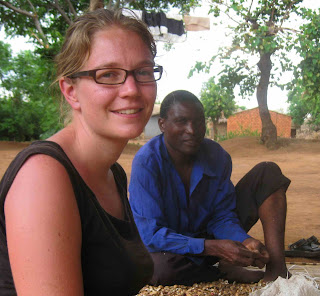
At about 1pm we were back and the house and eating a delicious lunch of nsima and fresh beans (I didn't know that was what beans tasted like when you ate them fresh from the plant!). After lunch, we were back to work. This time is was fairly light work... but good for my hand strength. We shelled groundnuts (like peanuts) for a few hours (see the other picture). This lasted quite a while, but it was fun and we got the chance to chat a little bit.

The sun began to set around 6pm as we sat down to our second nsima meal of the day. Again it was delicious and I was happy to eat well so that I would have lots of energy for the next morning. After dinner, we talked a little and I got to know the family a little better. We also listened to the radio for a while (no electricity so it was powered by batteries). By, 8 I was more than happy to curl up on my mat on the floor and get some sleep. A pretty fantastic, and exhausting day in the village all in all.

Wednesday, December 2, 2009

Fuel Problems

Malawi is experiencing a few problems getting enough fuel into the country. This means that there have been enormous lines at the pumps for the past few weeks. Word gets out that there is fuel arriving at a particular gas station and within an hour the gas station looks something like this.

On my way to the village last week I got a ride with some co-workers who were headed out of town in my direction. They left to find fuel at about 9am. I walked to the gas station around noon to join them. By 2pm we had fuel. And we were on our way!

I asked my co-worker if I could take a picture at the gas station while we were waiting. He said that people wouldn't be too happy to see me taking a picture. So, I gave him the camera and he stealthily took this picture. Here's hoping we get more fuel soon, because it's making getting around pretty difficult.

Monday, November 30, 2009

Rain

I've just arrived back in Lilongwe after spending a week in a village about one hour north of LL. I had a great time, worked really hard, and learned a lot. I'll be sharing more about my stay in the village in the next few days - hopefully after I revive my camera and retrieve some photos. Unfortunately (and quite humorously) I fell in a shallow well while I was in the village. The well, which was more like a hand dug pond, is used to water the vegetables during the dry season. Sadly, I had my camera in my pocket. I don't have a very good track record with cameras... but hopefully it will be ok when it dries. I'll share the pictures and stories as soon as I can.

While I was in the village the first big rains of the season came (the rain was very heavy, you might say torrential, for about an hour). The next day the air was full of flying ants. They have been especially bountiful in the evening when dusk comes. Yesterday evening, as I was walking home and the darkness was setting in the road was full of laughing children running around trying to catch the ants. Apart from providing a lot of entertainment ants are apparently very tasty. I'll let you know if I decide to try one.

Tuesday, November 10, 2009

Hey all!

I realize that after a particularly communicative October, I fallen silent for an extended period. Part of the reason was that I was working and enjoying some time in the beautiful Senga Bay. I spent a little bit over a week at the beach, first helping to run a leadership retreat for some of our Malawian counterparts (it was a wonderful experience and I'll write more about it soon), and then I was participating in an extended meeting with my fellow Engineers Without Borders volunteers in Southern Africa. The meetings involved some pretty long days, but at least we could meet on the beach and occasionally we were interrupted by a troop of nosy monkeys.


In other news, it's really hot here. I think we're getting daily highs in the mid-30s. The beach was especially hot. I'm looking forward to the arrival of the rains... which should be starting anytime!